

Ginger rarely gets the spotlight it deserves. It’s not flashy, it’s not new, and it doesn’t ride short-term trends. Yet behind the scenes, it powers global food systems, wellness industries, pharmaceuticals, and functional beverages. In 2026, ginger’s real transformation is happening not in farms—but in processing facilities.
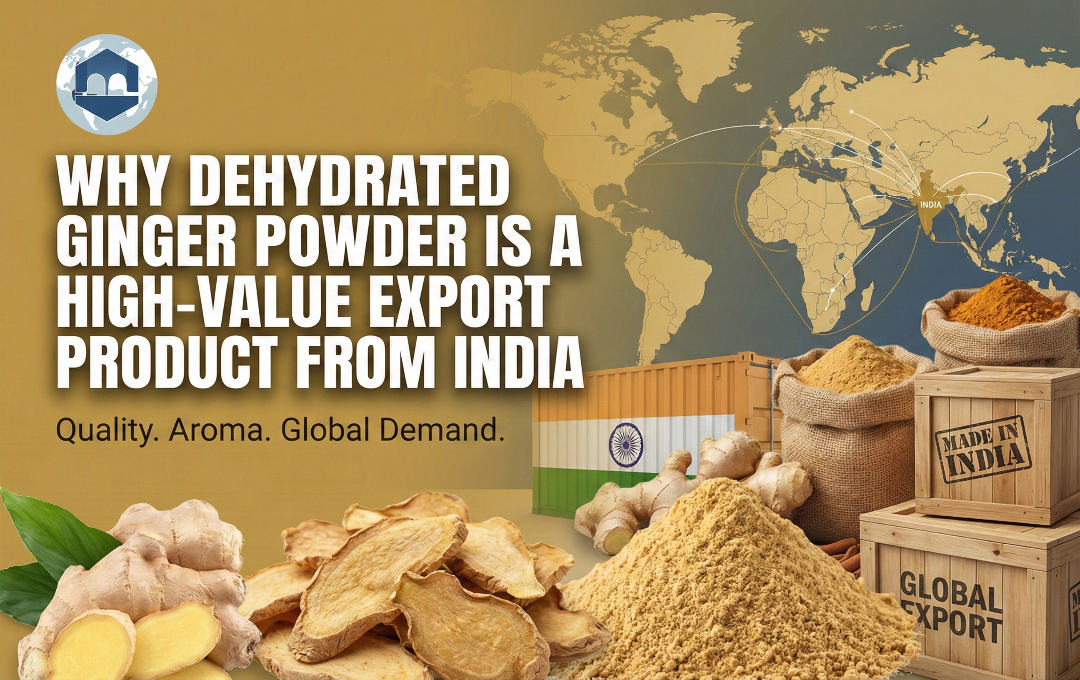
Dehydrated Ginger Powder has quietly evolved from a supporting spice into a strategic export commodity. With a projected global market value of USD 16.73 billion, rising demand for clean-label ingredients, and India’s position as the world’s leading ginger producer, this product now represents one of the most stable, scalable, and margin-rich opportunities in agricultural exports.
India contributes nearly 50% of global ginger production, but the real advantage lies in how that ginger is processed, standardized, and supplied to international markets. As global buyers shift away from raw commodities toward shelf-stable, specification-driven ingredients, Dehydrated Ginger Powder sits at the sweet spot between agriculture and industry.
India’s dominance in ginger is not accidental—it is structural. The country’s vast agro-climatic diversity allows ginger to be cultivated across multiple regions, each producing varieties suited for different high-value applications.
In Meghalaya, ginger is prized for its high gingerol and curcumin content. These bioactive compounds make it especially attractive for nutraceutical and pharmaceutical buyers in Europe, where efficacy and potency outweigh volume considerations. Kerala, on the other hand, produces ginger that is aromatic, bold, and low in fiber—qualities favored by gourmet food brands and premium spice formulators.
Beyond varietal diversity, India is rapidly expanding its organic ginger footprint. More than 10,000 acres across the Northeast and Odisha are targeted for organic certification during the 2025–26 cycle. This positions Indian Dehydrated Ginger Powder to command 20–30% price premiums in Western markets that prioritize organic and traceable sourcing.
India’s strength, therefore, is not just production scale—it is its ability to supply differentiated ginger aligned with specific global demand segments.
The export readiness of Dehydrated Ginger Powder lies in a combination of shelf stability, logistics efficiency, pricing leverage, and industrial reliability. Unlike fresh ginger, which behaves like a fragile agricultural commodity, dehydrated ginger powder functions as a manufactured ingredient—and global markets value it accordingly.
Fresh ginger has a limited post-harvest life and deteriorates rapidly without controlled storage. In contrast, properly processed Dehydrated Ginger Powder offers a 12 to 24-month shelf life without the need for preservatives.
This extended stability is a critical factor for international buyers. It allows for long-term inventory planning, reduces spoilage risk, and supports bulk procurement cycles. For exporters, it means fewer losses, less urgency in shipping timelines, and greater flexibility in contract fulfillment.
One of the biggest constraints in exporting fresh ginger is logistics. Refrigerated containers, faster transit requirements, and higher insurance costs significantly increase landed prices.
Dehydrated Ginger Powder eliminates these constraints. It does not require cold-chain infrastructure, is lighter in weight, and occupies less volume. These factors translate into lower freight costs, easier handling, and better scalability—especially for long-distance markets like the US and Europe.
For exporters operating on tight margins, this logistics efficiency is often the difference between profitability and price pressure.
The economic transformation from fresh ginger to dehydrated powder is substantial. While fresh ginger typically sells at ₹25–35 per kilogram at the farmgate, export-grade Dehydrated Ginger Powder commands ₹130–200 per kilogram in international markets.
Even after accounting for dehydration, milling, quality testing, packaging, and certifications, exporters can achieve 20–30% margins. This pricing power is not speculative—it is driven by consistent demand from food processors, nutraceutical brands, and pharmaceutical buyers who value uniformity over raw freshness.
Export markets are uncompromising when it comes to quality. Dehydrated Ginger Powder must typically maintain moisture levels below 8–12% to prevent microbial growth and ensure long-term stability.
Meeting these specifications requires controlled dehydration, batch testing, and standardized packaging—processes that elevate ginger from an agricultural product to an industrial input. Once these standards are met, the product becomes highly repeatable, specification-driven, and scalable.
Perhaps the most overlooked aspect of export readiness is how easily Dehydrated Ginger Powder integrates into industrial formulations. Unlike fresh ginger, which varies in potency and moisture, dehydrated powder offers consistent flavor strength, particle size, and chemical composition.
This consistency is essential for large-scale food, beverage, and pharmaceutical manufacturers who need predictable inputs for mass production.
The rising demand for Dehydrated Ginger Powder is rooted in structural shifts, not short-term trends.
The clean-label movement has pushed manufacturers toward recognizable, plant-based ingredients with functional benefits. Ginger fits this profile perfectly, supported by both traditional use and modern research.
Functional beverages are one of the fastest-growing segments. Ready-to-drink health drinks, immunity shots, and ginger-based mixers have surged, with RTD cocktails alone recording a 26.8% revenue increase. Dehydrated ginger powder provides the consistency and shelf stability these formulations require.
Geographically, demand is strongest in:
United States and Germany for nutraceuticals and clean-label foods
UAE, Morocco, and Malaysia for culinary, spice blends, and B2B food processing
In all these markets, buyers increasingly prefer sourcing directly from India to ensure traceability and cost efficiency.
From an investment lens, Dehydrated Ginger Powder offers rare balance—moderate risk, stable demand, and scalable returns.
Unlike fresh produce exports, dehydrated ginger powder is less exposed to seasonal volatility. Processing creates predictability, while certification opens doors to premium markets. Once dehydration infrastructure is established, capacity expansion becomes straightforward.
Industry experts also emphasize contract timing. Exporters who secure agreements in Q4—ahead of the January–March harvest—can hedge against price fluctuations and protect margins.
For many exporters, dehydrated ginger powder now functions as a portfolio stabilizer—not the highest-risk, highest-reward product, but one that delivers dependable performance year after year.
A mid-sized Indian processor initially focused on domestic fresh ginger sales faced recurring price volatility and limited growth. The company invested in dehydration facilities, moisture-control systems, and quality testing infrastructure.
It secured mandatory export documentation, including IEC, GST, and RCMC from the Spices Board of India, followed by ISO 22000, HACCP, and FSSAI certifications to access US and EU markets.
Within two export cycles, the company transitioned to long-term B2B supply contracts with nutraceutical and food manufacturers. Margins improved, demand stabilized, and dependency on domestic price swings reduced significantly—demonstrating the structural advantage of Dehydrated Ginger Powder exports.
The Indian processed ginger segment—including powder, oil, and flakes—is projected to grow at a 12–14% CAGR from 2026 to 2030. Buyers are prioritizing origin sourcing, traceability, and compliance over lowest-price procurement.
Ginger’s expanding use in cosmetics, personal care, and wellness supplements further broadens its market, reinforcing long-term demand.
It takes 5–7 kg of fresh ginger to produce 1 kg of dehydrated powder
Dehydration converts gingerol into shogaol, enhancing potency
Organic dehydrated ginger can command up to 30% higher prices
India can supply both volume and varietal diversity at export scale
Proper dehydration preserves most bioactive compounds
Dehydrated Ginger Powder is processed to low moisture levels (8–12%) and packed in moisture-resistant, food-grade packaging. This prevents microbial growth and oxidation, ensuring a 12–24 month shelf life without refrigeration, even during long international shipments.
The main risks are inconsistent pungency, high moisture content, and poor traceability. These issues typically arise from open drying and weak quality controls. Export-grade processing, batch testing, and certifications significantly reduce rejection and compliance risks.
Price variation reflects ginger variety, processing standards, moisture control, and certifications. Lower-priced powder may lack potency or stability, leading to higher downstream costs. Premium Dehydrated Ginger Powder delivers consistency, compliance, and better long-term value.
Yes, when processed under controlled conditions and supported by certifications such as ISO 22000 and HACCP. High-gingerol Dehydrated Ginger Powder is widely used in herbal medicines, dietary supplements, and functional health formulations globally.
Forward contracting in Q4, before the January–March harvest, helps lock pricing and volumes. Working with vertically integrated suppliers further reduces dependence on spot markets and ensures consistent quality and uninterrupted supply.
Closing Thoughts
The rise of Dehydrated Ginger Powder as a high-value export product reflects a broader shift in global trade—from raw commodities to processed, reliable ingredients. India’s agricultural base, combined with growing processing capabilities, places it at the center of this transition.
As global buyers seek consistency, compliance, and traceability, Indian suppliers with integrated supply chains are setting new benchmarks. Companies like Bulk In Global, with their farm-to-business approach and focus on export-grade quality, exemplify how Indian dehydrated ingredients are meeting global expectations.
In a world increasingly driven by efficiency and reliability, Dehydrated Ginger Powder is not just relevant—it is strategically indispensable.