

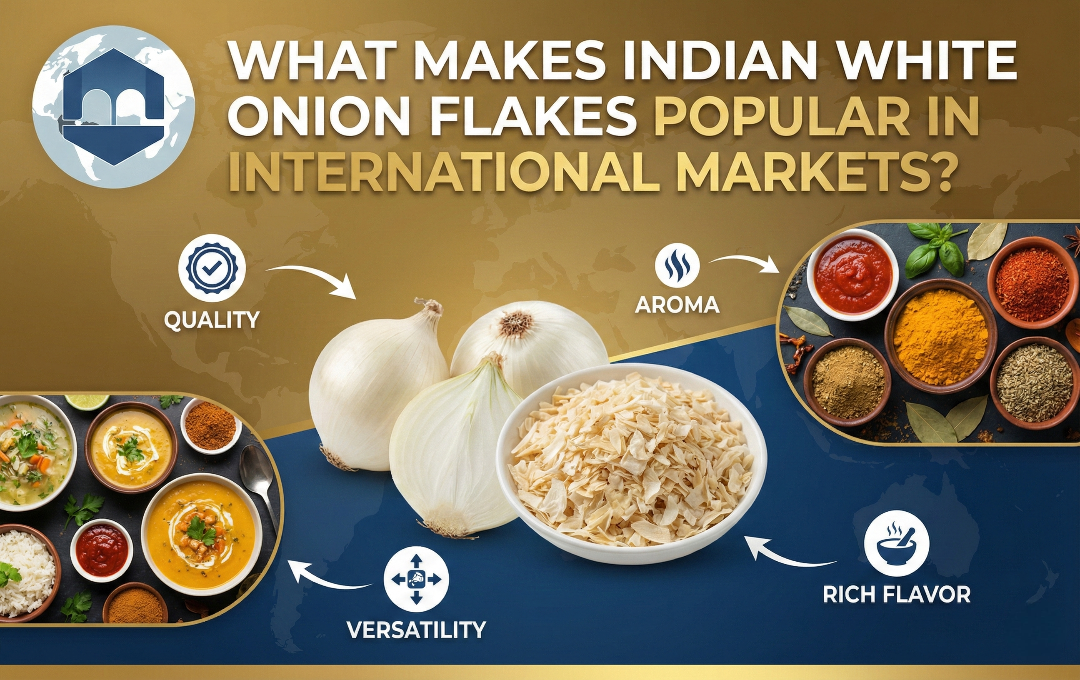
Across global food supply chains, few dehydrated ingredients have achieved the kind of consistent demand and trust that White Onion Flakes from India enjoy today. From large-scale food manufacturers in the United States to seasoning blenders in Europe and convenience food producers in Southeast Asia, Indian-origin onion flakes have become a preferred sourcing choice.
India’s dominance in the dehydrated onion segment is not accidental. It is the result of agricultural depth, processing expertise, cost efficiency, and an export ecosystem designed to serve international markets reliably. This article explores why White Onion Flakes from India continue to outperform alternatives—covering production scale, quality attributes, safety standards, applications, market trends, and long-term sourcing advantages.
For importers, bulk buyers, and food manufacturers, understanding these drivers is essential when evaluating sustainable ingredient partners in an increasingly competitive global market.
India is one of the world’s largest onion producers, supported by diverse agro-climatic zones and year-round cultivation cycles. This agricultural advantage ensures a steady supply of raw white onions, which is critical for producing White Onion Flakes at commercial scale without seasonal disruptions.
What sets India apart is not just cultivation volume, but the maturity of its dehydration infrastructure. Advanced dehydration facilities—using controlled drying, moisture regulation, and quality sorting—allow Indian processors to convert fresh onions into shelf-stable flakes while retaining flavor, aroma, and functional integrity. As a result, India contributes a majority share of the global dehydrated onion supply, reinforcing its position as a backbone supplier to international markets.
Certain regions have emerged as global centers for dehydrated onion processing, most notably Gujarat (Mahuva, Bhavnagar) and Maharashtra. These clusters specialize in dehydrated onion products, including White Onion Flakes, granules, and powders.
Regional specialization brings clear advantages:
Standardized processing techniques refined over decades
Skilled labor familiar with dehydration nuances
Infrastructure built specifically for export volumes
International buyers often prefer sourcing from these established clusters because consistency, scalability, and logistical readiness are already built into the supply chain.
One of the strongest reasons White Onion Flakes from India dominate international markets is cost efficiency. Large-scale cultivation, lower input costs, and labor efficiency significantly reduce per-unit production expenses. Combined with optimized dehydration processes, Indian exporters can offer competitive pricing without compromising quality.
When compared to onion flakes sourced from regions with higher labor or energy costs, Indian White Onion Flakes consistently deliver better value, especially for bulk procurement.
For international buyers, cost-effectiveness extends beyond price per kilogram. Indian suppliers often support:
Long-term supply contracts
Predictable pricing structures
Volume scalability as demand grows
This stability helps food manufacturers control input costs, protect margins, and plan production more effectively—key advantages in volatile global food markets.
Indian white onions are naturally rich in sulfur compounds, which directly influence pungency and aroma. During dehydration, these compounds translate into White Onion Flakes with robust flavor intensity and depth.
This makes Indian flakes especially desirable for applications where onion flavor must remain prominent even after cooking, rehydration, or blending with other ingredients.
Consistency is critical in industrial food production. Indian White Onion Flakes are processed with strict control over:
Flake size and mesh grading
Moisture levels
Color uniformity
The result is excellent rehydration performance and visual appeal—qualities essential for seasoning blends, sauces, soups, and ready meals where product appearance and texture directly affect consumer perception.
Indian exporters supplying White Onion Flakes to international markets typically operate under globally recognized certifications such as ISO 22000, HACCP, and BRC. These frameworks ensure food safety, hygiene, and risk management across the production chain.
Compliance with these standards is particularly important for access to regulated markets like the U.S., EU, and parts of Asia, where traceability and documentation are non-negotiable.
Beyond certifications, established Indian exporters invest in batch-level traceability, contamination prevention, and regular audits. Each shipment of White Onion Flakes is monitored for microbial safety, moisture content, and sensory consistency.
For private-label brands and multinational food companies, this level of control reduces risk and builds confidence in long-term sourcing partnerships.
Unlike fresh onions, White Onion Flakes offer a shelf life typically ranging from 12 to 24 months when stored properly. This extended stability eliminates the need for cold storage and significantly reduces spoilage risk during transit and storage.
For global buyers, this translates into fewer losses, longer inventory cycles, and improved supply chain efficiency.
Dehydrated flakes are lightweight, compact, and resistant to temperature fluctuations. These characteristics lower freight costs and simplify international shipping. Distributors and wholesalers benefit from easier handling, reduced warehousing complexity, and more predictable logistics planning.
The global rise of convenience foods has fueled demand for White Onion Flakes in products such as instant noodles, soups, sauces, and ready-to-eat meals. Manufacturers value the consistency these flakes provide, ensuring uniform flavor across large production runs.
Snack producers rely on White Onion Flakes for chips, crackers, dry rubs, and spice blends. The ability to deliver consistent onion notes across high-volume batches makes them indispensable in flavor standardization.
Quick-service restaurants and large foodservice operations use onion flakes to improve operational efficiency. With no peeling, chopping, or waste, White Onion Flakes support standardized recipes and reduce preparation time across multiple outlets.
As consumers move away from synthetic additives, food brands are reformulating with recognizable, natural ingredients. White Onion Flakes fit perfectly into clean-label strategies, delivering authentic onion flavor without artificial enhancers.
Plant-based foods increasingly rely on onion-derived ingredients to build savory depth. White Onion Flakes are widely used in meat analogues, vegan sauces, and plant-based ready meals to enhance umami and overall flavor complexity.
Major importing regions for White Onion Flakes include the United States, Europe, Southeast Asia, and Latin America. Demand is driven by food manufacturers, seasoning blenders, QSR chains, and distributors supplying both retail and foodservice channels.
Global demand for dehydrated onion products is expected to grow at a steady CAGR through the early 2030s. Within this landscape, Indian White Onion Flakes remain a low-risk sourcing choice due to their proven reliability, cost efficiency, and export readiness.
Indian exporters have the capacity to fulfill large, repeat orders year-round. This reduces dependence on seasonal suppliers and protects buyers from supply shocks.
For brands scaling internationally, White Onion Flakes from India align with long-term goals around cost control, quality assurance, and supply chain resilience.
Buyers should evaluate moisture levels, flake size, and packaging formats. Transparent suppliers of White Onion Flakes are open about specifications and customization capabilities.
Smooth customs clearance depends on accurate documentation and regulatory compliance. Experienced exporters minimize cross-border trade risks by managing these processes efficiently.
Why are Indian White Onion Flakes more pungent than others?
The answer lies in onion varieties and sulfur composition, which are naturally higher in Indian-grown white onions.
Are Indian White Onion Flakes suitable for clean-label products?
Yes. They are produced without synthetic additives, aligning well with clean-label requirements.
What is the typical shelf life of White Onion Flakes?
When stored in cool, dry conditions, shelf life generally ranges from 12 to 24 months.
Can White Onion Flakes replace fresh onions in industrial cooking?
In many applications, they offer superior efficiency, consistency, and cost control compared to fresh onions.
How do exporters ensure consistent quality across shipments?
Through standardized processing, testing, grading, and batch-level quality controls.
Which industries benefit the most from using White Onion Flakes?
Processed foods, snacks, QSR chains, seasoning manufacturers, and plant-based food producers.
The global popularity of Indian White Onion Flakes is built on a powerful combination of agricultural scale, cost efficiency, flavor strength, safety compliance, and logistical advantages. As international demand for shelf-stable, clean-label, and functional ingredients continues to rise, Indian onion flakes stand out as a dependable long-term sourcing solution.
For businesses looking to secure consistent supply, competitive pricing, and export-ready quality, choosing the right partner matters. Bulk In Global emerges as a strong option in this landscape—offering professionally sourced White Onion Flakes, backed by a vertically integrated supply chain, strict quality controls, and a deep understanding of global market requirements. For importers and food manufacturers aiming to strengthen their ingredient sourcing strategy, partnering with an experienced exporter like Bulk In Global can provide a measurable edge in international markets.