

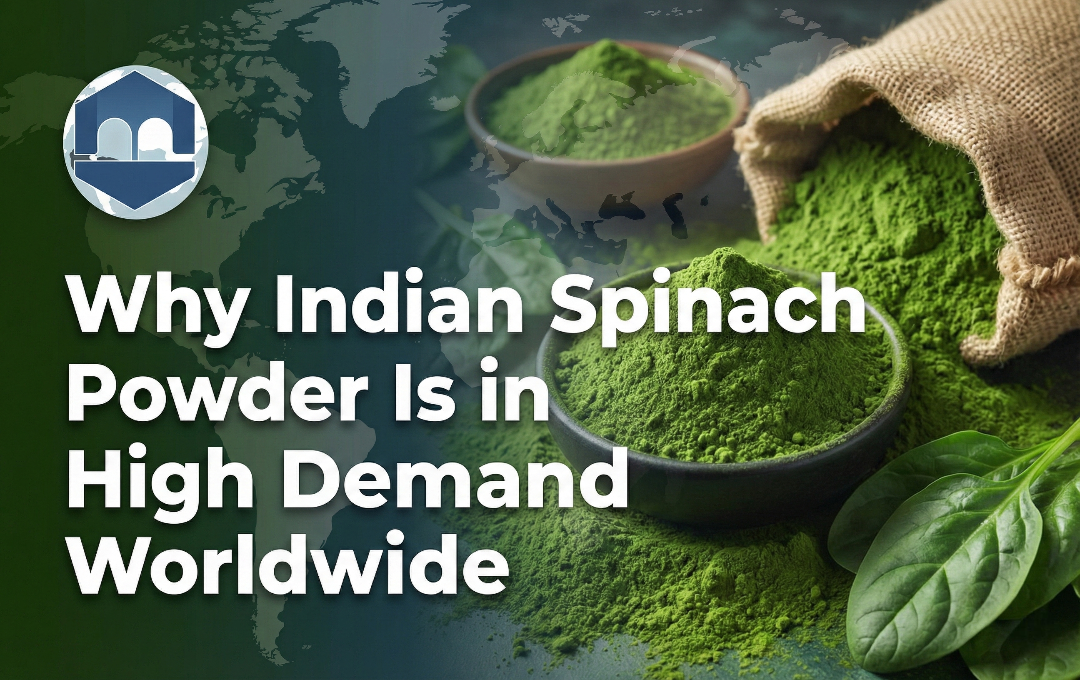
A few years ago, spotting spinach outside the vegetable aisle was rare. Today, it shows up everywhere—smoothie sachets, protein blends, supplement capsules, even premium skincare labels. What changed? The world quietly shifted. Health conversations moved from “eat your greens” to “optimize your nutrition,” and suddenly shelf-stable, plant-based superfoods became essential rather than optional.
Among them, Spinach Powder—especially sourced from India—has evolved from a niche wellness product into a globally trusted functional ingredient. Food manufacturers, nutraceutical brands, and health-focused consumers are no longer viewing it as a supplement; they see it as a practical, nutrient-dense solution aligned with modern lifestyles.
Behind this rising demand are clear drivers: powerful nutrition, cost efficiency, sustainable sourcing, versatile applications, and the accelerating global shift toward plant-based wellness. This article explores why Indian Spinach Powder is gaining worldwide momentum—through real market trends, health insights, and evolving global demand patterns.
Walk into any modern grocery store and you’ll notice a pattern: consumers want more nutrition in less volume. Convenience matters, but not at the cost of health. That’s where Spinach Powder stands out.
One tablespoon of Spinach Powder delivers nutrient density comparable to roughly one cup of fresh spinach. That concentration makes it incredibly appealing for health-conscious consumers and product formulators alike.
It is naturally rich in:
Vitamins A, C, and K
Iron and calcium
Antioxidants and dietary fiber
In a world where iron deficiency and lifestyle-related immunity concerns remain widespread, spinach-based nutrition is increasingly positioned as a natural immunity and vitality booster.
The numbers reinforce the shift. The global superfood market is expanding at nearly 12% CAGR through 2030, while post-pandemic demand for immunity-supporting ingredients rose 22% worldwide. Vegetable powders are now widely used in preventive healthcare, nutraceuticals, and functional nutrition.
Insight: Consumers are transitioning from fresh-only nutrition to concentrated, convenient plant nutrition, and Spinach Powder sits perfectly at that intersection.
Walk through supermarket aisles in the US or Europe and you’ll notice more vegan labels, fewer synthetic additives, and stronger clean-label messaging than ever before. This isn’t a trend—it’s a transformation.
Between 2014 and 2024, the global vegan population grew nearly 600%. Around 70% of consumers in Western markets actively seek nutrient-dense foods, and in 2025 alone, Spinach Powder appeared in nearly 40% of new functional food launches.
Consumers increasingly prefer:
Organic vegetable powders
Chemical-free food ingredients
Natural colorants and nutrient boosters
This clean-label shift has elevated Spinach Powder from supplement status to a mainstream functional ingredient used across food innovation ecosystems.
Insight: It is no longer just a health product—it’s becoming a core component of modern, clean nutrition systems.
Fresh spinach is nutritious—but highly perishable. Within days, it wilts, loses nutrients, and often ends up wasted. Spinach Powder solves this problem elegantly.
Powdered spinach dramatically reduces spoilage and extends usability for months without refrigeration. It supports busy lifestyles while enabling global distribution without nutrient loss.
The demand is not limited to food. Today, Spinach Powder is used across multiple sectors:
Food & Beverages – 60% market share (smoothies, soups, bakery, snacks)
Nutraceuticals – 30% (protein blends, supplements, wellness formulas)
Other industries – 10% (natural coloring, skincare, anti-inflammatory products)
India’s vegetable powder market reached USD 1.479 billion in 2023 and is projected to grow to USD 2.702 billion by 2032, reflecting strong cross-industry adoption.
Insight: Demand is not just growing—it’s diversifying across industries, multiplying consumption channels worldwide.
Global buyers consistently turn to India when sourcing Spinach Powder, and the reason goes beyond price—it’s about reliability, scale, and agricultural strength.
India’s major spinach-growing regions—Uttar Pradesh, Maharashtra, and Gujarat—benefit from favorable climatic conditions that support year-round production. This ensures steady supply even when seasonal disruptions affect other regions.
Modern dehydration techniques preserve nutrients, color, and flavor while ensuring hygiene and export compliance. Certifications such as APEDA, USDA Organic, and EU Organic reinforce international buyer confidence.
India’s spinach powder market has grown steadily:
USD 5.692M (2021)
USD 7.987M (2025)
Projected USD 15.541M by 2033 (CAGR 8.676%)
Insight: India is no longer just a supplier—it’s emerging as a global quality benchmark for Spinach Powder.
In global sourcing, consistency and pricing matter as much as quality. Indian suppliers have gained a strong foothold because they deliver both.
Production costs in India are typically 20–30% lower than in Europe or the United States, enabling large-scale, affordable supply without compromising quality.
Online superfood sales grew 30% in 2025, supported by faster shipping networks and improved export logistics.
Global imports from cost-efficient producers like India rose 25% year-on-year in 2024, reflecting strong buyer preference.
Insight: Competitive pricing combined with reliable supply creates long-term sourcing confidence for global manufacturers.
Demand for Spinach Powder is expanding far beyond niche or ethnic markets—it is entering mainstream global health ecosystems.
Between June 2024 and May 2025, India exported 78 shipments to 17 countries, marking 58% export growth year-on-year.
United States – 30%
United Kingdom – 25%
Sweden – 20%
India holds 17.5% market share in the Asia-Pacific region, with projected regional growth at 8.522% CAGR (2025–2033).
Insight: Demand is shifting from niche consumption to mainstream global adoption, driven by wellness and functional nutrition trends.
Modern consumers care not only about nutrition but also about environmental impact. Spinach Powder naturally aligns with sustainability goals.
Powdered form minimizes perishability losses, reduces storage requirements, and lowers transport emissions.
The sustainable ingredient market grew 8% in 2025, and 60% of consumers now prefer eco-friendly powders over perishable produce.
India’s expanding organic farming initiatives are further boosting global trust in responsibly sourced Spinach Powder.
Insight: Sustainability is no longer optional—it is a major purchasing driver, and spinach powder fits naturally into eco-conscious supply chains.
Innovation is pushing Spinach Powder far beyond traditional use.
Manufacturers increasingly blend spinach with turmeric, moringa, and spirulina to create advanced superfood formulations. It is now widely used in:
Functional beverages
Plant-based nutrition products
Cosmetic and anti-aging formulations
India’s food-tech investment grew 15% in 2025, while global product launches featuring Spinach Powder increased 20% in 2024.
Insight: Innovation is transforming spinach powder from a simple ingredient into a multi-industry wellness component.
Global Spinach Powder market projected to grow from USD 220.4M (2024) to USD 482.1M by 2032
Vegan product demand increased 15% in 2025
Included in 25% of new plant-based launches
Cosmetic usage rose 18% in 2024
Asia-Pacific leading growth (~9.2% CAGR)
Demand for sustainable powders accelerating rapidly
Insight: The trajectory shows a steady transformation—from ingredient → functional superfood → multi-industry raw material.
Balanced perspective strengthens credibility. Despite strong growth, the industry faces challenges:
Climate-driven supply fluctuations
Quality inconsistency among unregulated suppliers
Rising competition from other green powders
Need for strict certifications and standardization
Insight: Even with these challenges, demand remains strong, driven by long-term health and sustainability trends.
Nutritional density, convenience, and sustainability rarely come together in a single ingredient—but Spinach Powder achieves that balance effortlessly. Its concentrated nutrition supports modern health needs, while its shelf stability and versatility make it practical for global industries ranging from food to wellness and beyond.
India’s agricultural strength, cost efficiency, and growing export infrastructure have positioned it as a reliable global supplier. At the same time, rising innovation and sustainability awareness continue to expand spinach powder’s relevance across evolving markets.
For businesses exploring functional ingredients, nutraceutical sourcing, or plant-based product development, choosing a supplier that prioritizes purity, consistency, and export-grade processing becomes essential. Companies like bulkinglobal India, known for clean-label agro exports, advanced dehydration practices, and reliable global supply standards, represent the kind of dependable sourcing partners today’s market increasingly values.
As global health priorities continue to evolve, Indian Spinach Powder is not just growing in demand—it is becoming a strategic ingredient shaping the future of nutrition and sustainable food systems.
What makes Indian Spinach Powder different from others?
Indian Spinach Powder stands out for its nutrient density, cost advantage, organic sourcing potential, and strong export compliance backed by modern dehydration technology.
Is Spinach Powder as nutritious as fresh spinach?
Yes. In concentrated form, Spinach Powder delivers comparable nutrients in smaller quantities, making it a convenient alternative to fresh spinach.
Why is global demand for Spinach Powder increasing?
Demand is driven by plant-based diets, rising health awareness, preventive nutrition, convenience, and sustainability trends.
Which industries use Spinach Powder the most?
Food & beverages, nutraceuticals, functional nutrition, and cosmetic industries are the largest users.
Is Spinach Powder environmentally sustainable?
Yes. It reduces food waste, improves shelf life, and lowers transportation emissions compared to fresh produce.
Which countries import the most Indian Spinach Powder?
The United States, United Kingdom, and health-focused European markets are among the largest importers.