

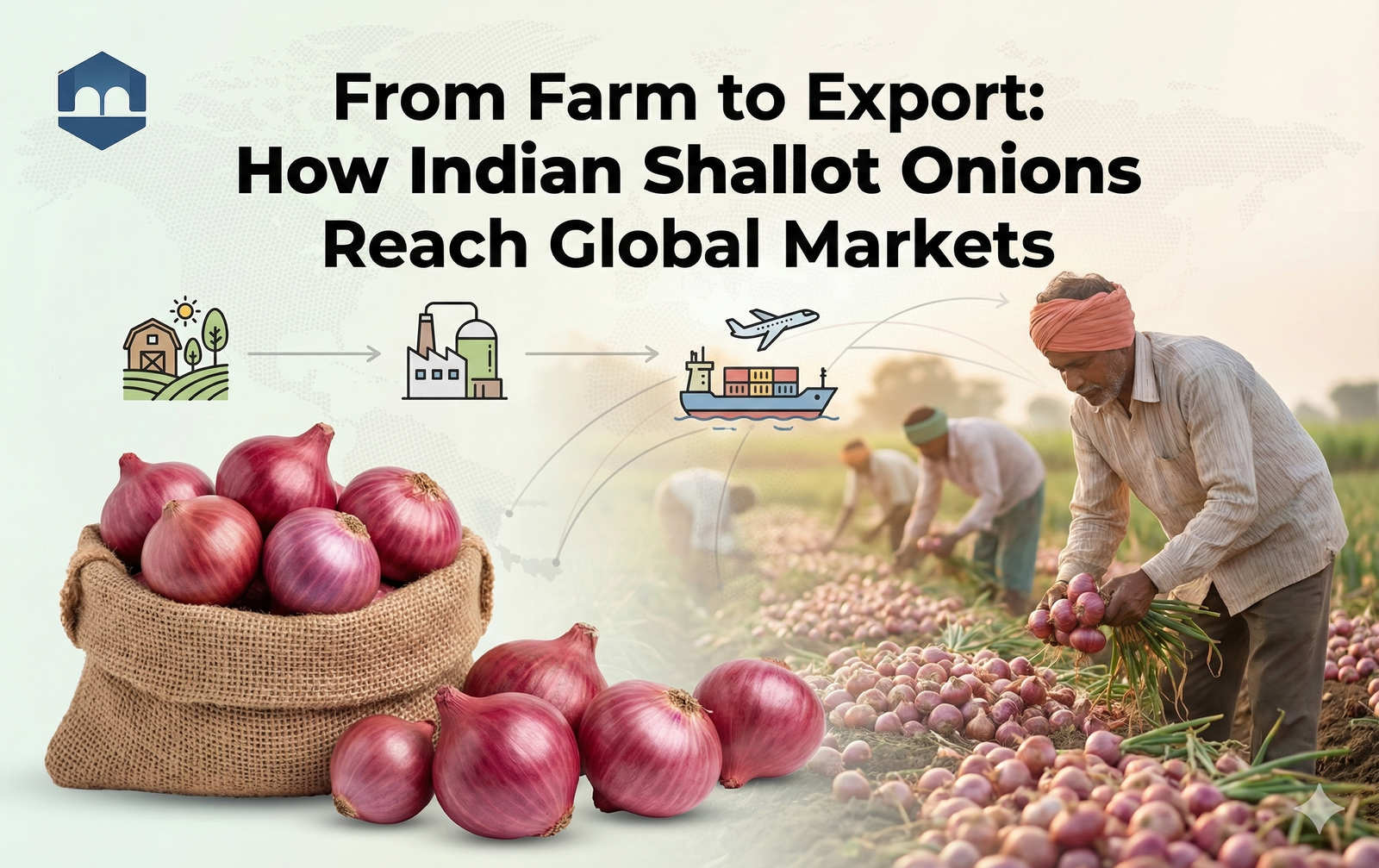
India has long been recognized as one of the world’s most influential players in the onion trade. Yet within this vast category, a smaller, more refined variety has steadily carved out its own global demand—Shallot Onions. Known for their intense flavor, compact size, and versatility, these onions travel an intricate journey before landing on international shelves and kitchen counters.
This article unpacks that journey end to end. From the fields where they are cultivated to the ports where they are shipped abroad, we explore how Indian Shallot Onions move through a complex system of farming practices, quality controls, logistics, and global market dynamics—revealing why they remain a high-potential export commodity.
Unlike regular bulb onions, Shallot Onions are prized for their sharper aroma, sweeter undertones, and layered texture. Their smaller size makes them ideal for gourmet cooking, sauces, pickling, and processed food applications. In many global cuisines—particularly across Southeast Asia, the Middle East, and parts of Europe—shallots are not just an ingredient but a flavor foundation.
Their relatively longer shelf life, when handled correctly, adds to their export viability. As international food trends shift toward authentic regional flavors and premium ingredients, demand for Indian Shallot Onions has steadily grown, driven by both household consumption and industrial food processing.
India’s advantage in producing Shallot Onions lies in its diverse agro-climatic conditions. States such as Tamil Nadu, Karnataka, Maharashtra, and Andhra Pradesh offer ideal combinations of soil texture, temperature, and rainfall patterns suited to shallot cultivation.
Most production comes from smallholder farmers operating in regional clusters, where generational knowledge plays a crucial role. Seasonal cycles dictate planting and harvesting windows, and productivity benchmarks vary by region. While yields are generally stable, consistency remains a key focus area—especially for export-grade produce.
Export-quality Shallot Onions begin with the right seed selection. Varietal purity ensures uniform bulb size, color, and flavor—attributes closely monitored by international buyers. Farmers increasingly adopt sustainable input management practices, balancing fertilizers and water usage to maintain soil health and crop resilience.
Pest and disease control is another critical factor. Export markets demand low residue levels, pushing farmers to align cultivation methods with global safety standards. Harvest timing plays a decisive role as well; bulbs harvested too early compromise storage life, while delayed harvesting increases spoilage risk.
Despite best practices, farmers face challenges in maintaining uniformity across large volumes—making post-harvest handling just as important as cultivation itself.
Once harvested, Shallot Onions undergo curing and drying to reduce moisture content and strengthen outer skins. This step is essential for preventing rot during storage and transit. Sorting and grading follow, separating export-grade bulbs based on size, appearance, and firmness.
In many regions, handling remains semi-manual, allowing for careful inspection but also introducing variability. Efficient loss reduction strategies—such as improved drying infrastructure and better storage conditions—have become central to preserving quality across the supply chain.
International markets impose strict benchmarks for Shallot Onions, covering parameters such as bulb size uniformity, moisture levels, and external appearance. Phytosanitary certifications ensure shipments are free from pests and diseases, while food safety norms regulate chemical residues.
Traceability has emerged as a non-negotiable expectation. Buyers increasingly demand transparency—knowing where the produce was grown, how it was handled, and whether it meets compliance standards consistently. This reliability is what transforms one-time buyers into long-term partners.
Packaging plays a silent but critical role in export success. Shallot Onions are typically packed in ventilated bags or boxes designed to prevent moisture buildup while maintaining airflow. Weight norms and labeling standards vary by destination, making accuracy essential.
Storage decisions depend on transit duration and market requirements. While cold storage can extend shelf life, many shipments rely on optimized ambient storage combined with efficient logistics to balance cost and quality during transport.
The export journey of Shallot Onions involves multiple stakeholders—aggregators, exporters, transporters, and port authorities. Inland transportation remains a challenge due to road conditions and transit delays, but improved coordination has reduced risks significantly.
At ports, documentation, inspections, and handling timelines determine shipment efficiency. Any disruption at this stage can affect product quality, making risk management a critical component of the export process.
Key importing countries value Indian Shallot Onions for their flavor intensity and cost competitiveness. Demand often fluctuates seasonally, influenced by local harvests in importing regions and festive consumption cycles.
Pricing remains sensitive to quality. Consistent size, appearance, and shelf life command premiums, allowing Indian exporters to compete effectively against other origins when standards are met reliably.
The export of Shallot Onions contributes directly to farmer incomes and rural employment, supporting livelihoods across cultivation, sorting, logistics, and trade. As quality awareness improves, opportunities for export growth increase—particularly through better branding and market positioning.
Establishing Indian Shallot Onions as a dependable, premium offering remains a long-term opportunity tied closely to consistency and compliance.
Despite strong demand, exporters face persistent challenges. Weather variability impacts yields, while price volatility and policy changes can affect trade flows. Infrastructure gaps—especially in storage and transport—add pressure, and compliance costs remain high for smaller exporters navigating international regulations.
The future of Shallot Onions exports lies in technology adoption, from precision farming to improved logistics tracking. Supportive policies, combined with farmer education and better infrastructure, can strengthen India’s global position.
Above all, building trust through reliability—delivering the same quality, shipment after shipment—will shape long-term success.
The journey of Shallot Onions from Indian soil to global kitchens is a story of coordination, discipline, and evolving standards. Their export success depends not on volume alone, but on quality, compliance, and consistency at every stage.
For businesses operating within this ecosystem, understanding these dynamics is essential. Companies like Bulk In Global, with a strong focus on traceable sourcing, quality-driven processes, and global market alignment, reflect the direction in which India’s agricultural exports are heading—connecting Indian produce with international demand responsibly and reliably.
As global appetites continue to evolve, staying informed and aligned with quality expectations will remain key for growers, exporters, and buyers navigating the international trade of Shallot Onions.