


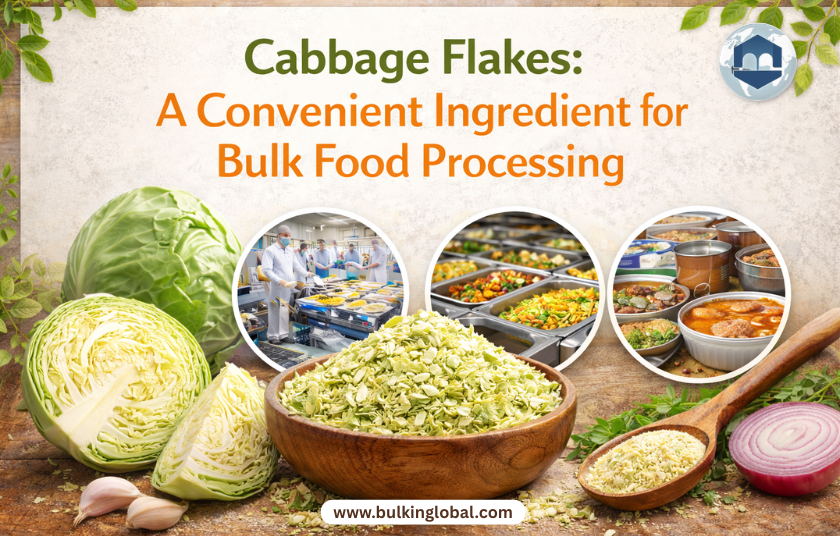
As food manufacturing scales up, ingredients are no longer judged solely by taste or tradition—they’re evaluated on efficiency, stability, and consistency. In this environment, cabbage flakes have emerged as a quietly reliable solution for bulk food processing. They offer the nutritional and functional benefits of cabbage while eliminating many of the logistical challenges associated with fresh produce.
With the global food industry moving toward shelf-stable formats and streamlined operations, demand for dehydrated vegetable ingredients is rising steadily. Cabbage flakes fit squarely into this shift, supporting manufacturers who need dependable inputs that perform consistently across batches. This article explores what cabbage flakes are, how they’re produced, why they matter in bulk processing, and what to consider when sourcing them at scale.
Cabbage flakes are dehydrated pieces of cabbage processed to remove moisture while maintaining structure, flavor, and functional properties. Unlike fresh cabbage, they are lightweight, shelf-stable, and easy to store, making them suitable for industrial use.
They are distinct from other cabbage formats. Fresh cabbage requires cold storage and immediate handling, while cabbage powder is finely ground and primarily used for flavoring. Dehydrated cabbage shreds are longer-cut and often chosen for visual presentation. Cabbage flakes occupy a middle ground, offering both texture and versatility, which is why they’re commonly used in processed cabbage ingredients for bulk applications.
The production of cabbage flakes involves controlled dehydration methods designed for food processing environments. Fresh cabbage is first selected for quality, then washed, cut into uniform pieces, and dehydrated using industrial drying systems. The final stages focus on moisture control, sorting, and quality testing.
For bulk food processors, the emphasis is not just on drying but on achieving consistency, safety, and repeatability. Proper dehydration ensures the flakes rehydrate predictably and maintain stability throughout their shelf life.
Fresh vegetables present challenges at scale—short shelf life, storage constraints, and spoilage risks. Cabbage flakes address these issues directly. As a shelf-stable vegetable ingredient, they can be stored for extended periods without refrigeration, reducing waste and simplifying inventory management.
Their long life and ease of handling allow manufacturers to plan production cycles more efficiently, particularly in environments where raw material availability fluctuates.
From a cost perspective, dehydrated cabbage flakes offer tangible benefits. They require less storage space, reduce transportation weight, and eliminate the need for cold-chain logistics. Additionally, reliance on seasonal harvests is minimized, helping manufacturers maintain consistent output year-round.
For large-scale processors, this translates into predictable sourcing and stable formulation outcomes, both of which are critical in high-volume production.
While dehydration removes water content, it does not eliminate nutritional value entirely. Cabbage flakes retain dietary fiber and essential minerals, contributing to the overall nutritional profile of finished products. Some heat-sensitive vitamins may reduce during processing, but when used appropriately, dehydrated vegetables still play a meaningful role in balanced formulations.
Functionality is where cabbage flakes stand out. They rehydrate effectively when exposed to moisture, integrate smoothly into mixes, and contribute texture without overpowering other ingredients. Their neutral flavor profile allows them to absorb surrounding seasonings, releasing flavor gradually during cooking or reconstitution.
This makes them particularly useful in processed foods where uniformity and performance matter more than visual freshness.
In ready-to-eat and convenience foods, cabbage flakes are commonly used in instant soups, meal kits, and noodle cups, where quick rehydration and consistency are essential. Their uniform size ensures even distribution throughout the product.
In snack and savory manufacturing, they appear in seasoning blends, fillings, and savory mixes, enhancing texture and visual appeal while supporting flavor balance.
Foodservice and institutional kitchens also benefit from cabbage flakes. Large-scale operations value reduced prep time, lower waste, and easier portion control—advantages that directly impact labor efficiency and cost management.
When sourcing cabbage flakes in bulk, buyers should assess physical characteristics such as color consistency, flake size, aroma, and residual moisture levels. These indicators influence both shelf life and performance in finished products.
Food safety and compliance are equally critical. Reliable suppliers provide clear documentation, batch traceability, and adherence to relevant testing standards. For export-oriented or large-scale manufacturers, consistency across shipments is non-negotiable.
Storage also plays a role. Properly packaged cabbage flakes should be kept in cool, dry conditions, protected from moisture and direct sunlight. Packaging quality and handling practices directly affect long-term stability.
The global bulk food ingredients market is seeing increased adoption of dehydrated vegetables, driven by the growth of convenience foods and the need for more resilient supply chains. Manufacturers are prioritizing ingredients that simplify operations while maintaining formulation flexibility.
Alongside demand growth, sustainability considerations are shaping sourcing decisions. Cabbage flakes help reduce food waste compared to fresh cabbage, require fewer transportation resources, and support more efficient storage—aligning well with sustainable food processing goals.
Interesting facts worth noting:
Dehydrated vegetables often reduce post-harvest waste significantly compared to fresh produce. Shelf-stable formats can lower logistics emissions by minimizing cold storage needs. Cabbage flakes typically rehydrate to multiple times their dry volume, improving yield efficiency. Uniform dehydration helps ensure batch-to-batch consistency in industrial formulations.
A common misconception is that flakes are interchangeable with powders. In reality, flakes provide texture and structure, while powders serve a different functional purpose. Another assumption is that dehydration removes all nutritional value, which isn’t accurate when processing is done correctly. Understanding the intended use case is key to getting the best results from cabbage flakes.
Advances in dehydration technology are improving nutrient retention and product uniformity, expanding the potential applications of cabbage flakes. As clean-label and convenience-driven products continue to grow, their role in food manufacturing is expected to strengthen.
For processors seeking ingredients that balance efficiency, functionality, and scalability, cabbage flakes are likely to remain a practical choice.
Cabbage flakes have established themselves as a dependable ingredient in bulk food processing, offering advantages in shelf life, cost control, functional performance, and operational efficiency. Their versatility across applications—from ready meals to foodservice—makes them a valuable component in modern manufacturing strategies.
Selecting the right supplier is essential to realizing these benefits. While the market includes multiple sourcing options, businesses evaluating dehydrated cabbage ingredients may consider experienced bulk suppliers such as Bulk In Global, alongside other qualified providers, when assessing quality consistency, documentation, and supply reliability.
As the food industry continues to evolve, cabbage flakes represent a smart, adaptable ingredient choice for manufacturers focused on long-term efficiency and scalable production.