

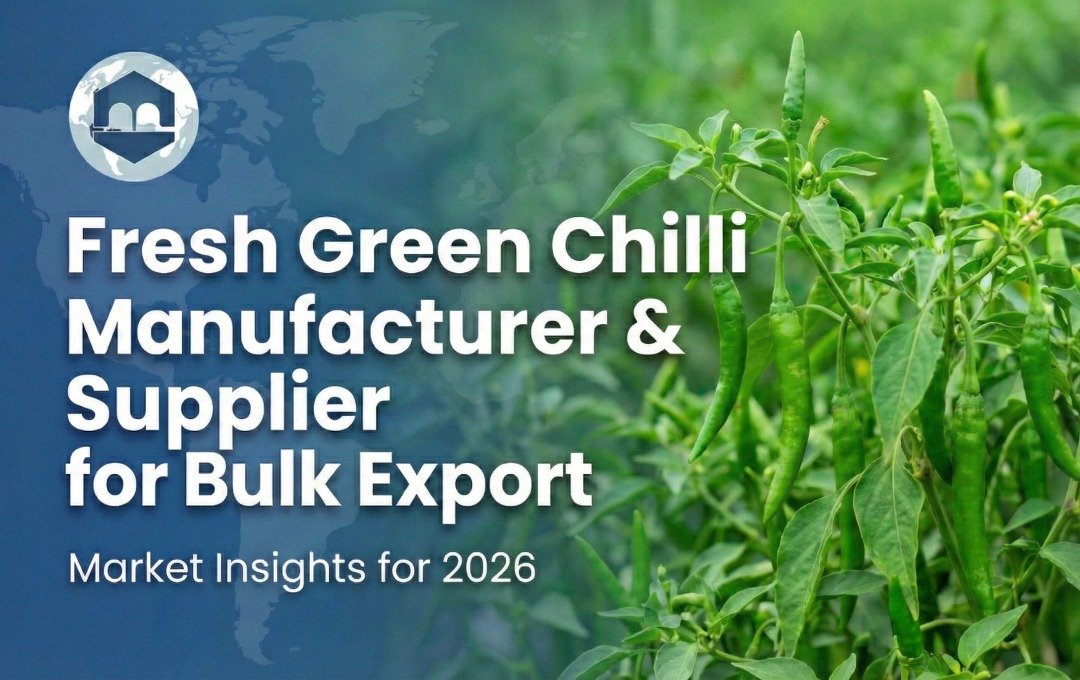
In global agricultural trade, few commodities balance volume, velocity, and value quite like fresh green chilli. What was once considered a regional staple has evolved into a year-round, cross-border necessity—fuelled by globalized cuisines, expanding foodservice industries, and growing demand for fresh, pungent ingredients.
By 2026, fresh green chilli is no longer just about heat. It represents consistency, shelf-life control, residue compliance, and logistics precision. India’s dominance in this segment continues to strengthen, not merely because of production scale, but because of its ability to adapt to changing buyer expectations across international markets.
This article breaks down global demand patterns, export dynamics, pricing realities, sourcing regions, and supplier evaluation criteria, helping buyers, importers, and distributors make informed decisions—especially when choosing reliable bulk export partners.
The global consumption of fresh green chilli is on a steady upward trajectory, with demand projected to grow consistently through 2026. The drivers are clear:
Expansion of ethnic cuisines across continents
Rising HoReCa (Hotel, Restaurant, Catering) demand
Growth in ready-to-cook and fresh ingredient segments
Increased household usage in urban markets
Middle East (UAE, Saudi Arabia, Qatar): High preference for pungent, long varieties used in daily cooking
Europe (UK, Netherlands, Germany, Italy): Strong demand driven by ethnic retail, food processors, and strict quality standards
Asia-Pacific (Bangladesh, Malaysia, Singapore): Price-sensitive bulk demand with consistent volume requirements
Migration-driven food cultures and year-round consumption habits continue to reshape the international chilli trade, making supply consistency as important as pricing.
The versatility of fresh green chilli drives its global relevance:
Culinary & Foodservice: Fresh cooking, curries, sauces, marinades, and pickles
Food Processing: Frozen green chilli, chilli paste, blended spice bases
Pharmaceutical & Nutraceutical: Capsaicin extraction for medicinal formulations
Retail & Ethnic Grocery Chains: Fresh produce counters and bulk resale
Each use case influences export specifications, including size grading, pungency levels, moisture control, and packaging formats—making supplier expertise non-negotiable.
India remains the world’s leading exporter of fresh green chilli in 2026, backed by three core strengths:
Climatic Advantage: Multiple growing seasons across regions
Varietal Diversity: Catering to different pungency and shelf-life needs
Skilled Farming Clusters: Decades of crop specialization
Government support through APEDA, improved traceability systems, and evolving export compliance frameworks have further strengthened India’s position in the Indian chilli supply chain.
Export success depends as much on logistics as on cultivation:
Middle East: Preference for pungent, long varieties with strong aroma
European Union: Residue-free produce, traceability, and certification compliance
Asian Markets: Bulk volume focus with competitive pricing
Exporters strategically choose between sea freight and air freight based on shelf-life expectations, order urgency, and destination regulations. Ports like Mumbai and Navi Mumbai remain critical gateways for efficient global distribution.
G4 Green Chilli: Uniformity, longer shelf life, high export acceptance
Teja (S17): Known for intense pungency, favored in Middle Eastern markets
VNR 978: Hybrid variety offering consistency and transit resilience
Variety selection directly impacts pricing, rejection risk, and buyer satisfaction, making it a strategic decision rather than a farming afterthought.
Pricing for fresh green chilli fluctuates based on:
Seasonal supply cycles
Weather conditions
Order volumes
Destination requirements
Export contract pricing often offers greater stability compared to domestic mandi rates. Buyers in 2026 must also account for rising compliance costs, freight volatility, and quality risk mitigation.
Proper handling defines export success:
Standard packaging includes ventilated carton boxes and graded gunny bags
Moisture control and airflow prevent spoilage
Shelf life varies by destination and transit mode
Cold chain management significantly reduces transit losses
Exporters with robust post-harvest systems consistently outperform price-only suppliers.
Guntur, Andhra Pradesh: Asia’s largest chilli trading hub
Maharashtra Belts: Buldhana, Jafrabad, Nashik known for consistent quality
Mumbai & Navi Mumbai: Strategic export logistics centers
Sourcing geography directly impacts scalability, uniformity, and year-round availability.
India’s export ecosystem includes several established names such as Vijayakrishna Spices Private Limited, Pramoda Exim Corporation, Bombay Fruits & Vegetables Import Export Pvt Ltd, Finesse Market Link, Hem Global Enterprise, and AA Intrade Ventures Private Limited.
However, in 2026, buyers increasingly prioritize operational depth, compliance readiness, and long-term reliability over brand familiarity alone.
What differentiates Bulk In Global is not just scale—but structure.
Rooted in India’s agricultural heartland, Bulk In Global operates with a farm-to-business mindset, emphasizing sourcing transparency, quality consistency, and export-grade compliance. With deep experience in handling bulk agricultural and dehydrated ingredients, the company understands what international buyers value most: predictability, documentation clarity, and repeatable quality.
Rather than chasing spot prices, Bulk In Global focuses on building dependable supply relationships—making it a natural choice for buyers seeking scalable, compliant fresh green chilli exports without operational surprises.
Modern buyers expect exporters to meet stringent requirements:
APEDA registration
EU pesticide residue norms
Phytosanitary certification
Pre-shipment inspections
Compliance is no longer optional—it directly influences buyer trust and repeat business.
Key evaluation criteria include:
Transparent farm sourcing
Variety specialization
Export-ready packaging and logistics
Clear communication and documentation
Red flags include inconsistent grading, vague compliance claims, and unstable supply networks.
The fresh green chilli market shows strong long-term sustainability. Growth in value-added products, emerging private-label sourcing trends, and new import markets continue to open opportunities for structured exporters.
Buyers focusing on long-term partnerships—not transactional sourcing—stand to gain the most.
The global market for fresh green chilli remains resilient, demand-driven, and opportunity-rich. India’s leadership, supported by strong farming ecosystems and evolving compliance standards, continues to shape international supply.
For buyers, the real differentiator lies in choosing reliable, scalable, and transparent partners—exporters who understand not just produce, but process.
For those seeking consistency, compliance, and confidence in bulk sourcing, exploring partnerships with Bulk In Global represents a strategic step forward in the evolving global fresh green chilli trade.